
What to Do If You Miss a Connecting Flight
Missed your connecting flight? Here are 10 options to get rebooked fast, claim compensation, and protect your trip — with honest advice from Dream Book Travel.

Your flight just got cancelled. The departure board flipped, the gate emptied, and now 200 people are sprinting toward the same two agents. Stop. The travelers who get on the next flight first are not the ones who panic , they’re the ones who know exactly what to ask for before they reach the desk. Here’s how to handle it.
Dream Book Travel is an editorial-first travel site built around one premise: give you the advice a well-traveled friend would give , including what to skip and what the other sites won’t say. When your flight goes sideways, that honest framing matters more than a generic checklist.
We pull together the actual rights framework (DOT rules for US flights, EU 261 for European routes), name the specific services worth using (and flag their fees), and tell you when to push back and when to let it go. The coverage spans every layer of a cancellation: rebooking, refunds, hotel vouchers, credit card claims, travel insurance, and third-party compensation services.
What makes Dream Book Travel worth bookmarking before your next trip is the layering. The Book pillar covers flight strategy, points optimization, and booking timing. The Travel pillar goes deeper on on-the-ground logistics. So if a cancelled flight forces you to reroute, rebuild, or rethink your whole itinerary, you have somewhere to go that isn’t stuffed with affiliate links and star ratings from 2019.
One honest caveat: Dream Book Travel is an editorial site, not a compensation service. We won’t file a claim for you. But we’ll tell you exactly who will, what they charge, and whether it’s worth it , which is what you actually need right now.
Key Takeaway: Bookmark Dream Book Travel before your next trip so the guidance is there the moment something goes wrong , not after you’ve already accepted a voucher you didn’t have to take.
The first thing most people do when a flight cancels is join the queue at the gate. That’s the wrong move. While you’re standing in that line, call the airline’s dedicated cancellation line at the same time. The phone agent and the gate agent have identical tools , but you can be talking to the phone agent in five minutes while the line doesn’t move for forty.
If the US line has a long hold, try dialing the airline’s international customer service number. It often connects faster during a widespread disruption because fewer people know about it. The number is usually on the airline’s website under “contact us” or “customer service.” Some airlines also let you rebook directly through their app, which is worth opening while you wait.
Come into the call with a plan. If you can say “I need to get to Barcelona , I see a 4:15 departure on your airline and a 6:00 on your partner carrier, can you put me on one of those?” you’ll move twice as fast as someone asking “what can you do for me?” Agents work faster when you give them something specific to work with.
One thing worth knowing before you even get to the airport: the timing of when you booked your flight can affect your rebooking options. Flights booked on more flexible fare classes often open up partner airline slots that basic economy won’t touch. If you’re regularly flying on stripped-down fares, that’s a real trade-off to factor in next time.
Budget carriers are a specific pain point here. A budget airline running one daily flight on your route has nowhere to put you until tomorrow. A mainline carrier running six daily departures on the same route has options. That’s not a reason to never fly budget , it’s a reason to know what you’re giving up before you book.
Before you agree to whatever the airline offers first, know that you have choices , and what you say yes to right now determines what you can ask for later.
In the US, airlines are required to rebook you on the next available flight on their network when they cancel. But “next available” can mean a red-eye two days from now. You’re not locked into that. You can ask to be rebooked on a partner airline if the wait is unreasonable, and many major carriers will honor that request during significant disruptions. It never hurts to ask specifically: “Can you check your partner airlines for an earlier option?”
Read anything you’re asked to sign carefully. If you’re bumped due to overbooking and the airline offers you a travel voucher, signing that form may waive your right to cash compensation. Involuntary bumping compensation limits vary by route and are set by DOT rules. Accepting a low-value voucher without checking what you’re owed in cash could be a costly mistake.
One thing many travelers don’t realize: if the new flight the airline offers doesn’t work for you , wrong day, terrible layover, forces you to miss the event you were flying to , you are not obligated to take it. You can decline the rebooking entirely and request a full refund instead. More on that in the next section.
The reason the delay happened also matters for what you’re owed beyond rebooking. Mechanical issues and staffing problems are the airline’s fault. Weather and air traffic control delays generally aren’t. That distinction drives what meal vouchers, hotels, and ground transportation you can claim , and it’s the first question to ask once you have your new flight sorted.
Pro Tip: Before you leave home, check the DOT Airline Dashboard to see exactly what your specific carrier has committed to providing during controllable cancellations , that information is more useful at the gate than any general list of rights.
This is the piece most airlines won’t lead with. Under US Department of Transportation rules, if your flight is cancelled for any reason , including weather , and you choose not to travel, you’re entitled to a full cash refund. Not a voucher. Not miles. Cash back to your original payment method.
The key phrase is “choose not to travel.” If you accept the rebooked flight and take it, you’ve forfeited the refund. But if the replacement flight is so bad that you’d rather scrap the trip entirely , or take the train, or drive , you can decline the rebooking and get your money back. The same applies if the new flight departs more than three hours later on a domestic route or six hours later on an international one.
Refunds should happen automatically and promptly: within seven days if you paid by credit card, within 20 days if you paid by another method. If an airline tries to push you toward a travel credit instead, you are not required to accept it. The carrier must clearly inform you that a cash refund is an option. If they don’t say that, ask directly.
Think carefully before accepting miles as compensation. Let’s say you’re owed a refund on a ticket and the airline offers miles instead. Whether that’s a good deal depends entirely on how much those miles are actually worth to you , and airlines have a habit of devaluing their programs over time. A cash refund locks in real money. Miles are speculative. If you do accept miles, use them soon.
One scenario worth knowing: say you fly the outbound leg of a round trip but the return gets cancelled. You can get a refund for the return portion only, even though you already used the outbound. The refund applies to any unflown segment of the ticket.
If your flight cancels for a reason within the airline’s control , a mechanical problem, a crew shortage, an operational scheduling issue , you have standing to ask for accommodation, meals, and transport to and from that hotel. Many major US carriers have committed to providing these as part of the DOT’s airline customer service dashboard. That commitment is voluntary, but they’ve made it publicly, and you can hold them to it.
The critical word is “ask.” Airlines don’t always hand these out automatically. Walk up to the service desk and specifically request a hotel voucher, meal vouchers, and ground transportation. If the agent says they can’t provide it, ask to speak with a supervisor and reference that the carrier has committed to these accommodations for controllable disruptions on the DOT dashboard.
Here’s what you should not expect: any of this for weather delays. If a snowstorm grounds your flight, the airline is not legally required to put you up for the night. Some will as a goodwill gesture. But if they don’t, your next line of defense is your credit card’s trip delay coverage , not the airline’s voucher desk.
Keep every receipt from the moment your flight cancels. Hotel. Dinner. The cab from the hotel back to the airport. Even if the airline gives you a voucher, it may not cover everything. Documented out-of-pocket expenses are the basis for every other claim you’ll make , credit card reimbursement, travel insurance, or a direct complaint to the DOT if the airline doesn’t follow through.
If you’re flying in Europe and your flight cancels, “duty of care” is not discretionary , it’s legally required under EU regulation 261, regardless of whether the disruption counts as an extraordinary circumstance. Meals, hotel, transport to and from the hotel: the airline owes you these even when it doesn’t owe you cash compensation.
Most travelers don’t realize their credit card already has travel protection built in. If you paid for the flight with a card that includes trip delay or cancellation coverage, you may be able to claim back hotel nights, meals, and incidentals that the airline wouldn’t cover.

The Chase Sapphire Preferred, for example, reimburses nonrefundable trip costs up to $10,000 per occurrence for trips cancelled or interrupted due to a covered reason. That’s a meaningful safety net for a trip that goes sideways. Coverage kicks in after a delay exceeds a certain threshold , often six hours or an overnight stay , and it covers reasonable expenses incurred because of that delay. A new toothbrush: probably covered. Three pairs of shoes: no.
To actually get reimbursed, you need to document everything in the moment. Get written confirmation from the airline of the delay or cancellation and its stated cause. Keep physical or digital receipts for every expense. Save confirmation emails and boarding passes. If you don’t have a receipt, you can’t submit for reimbursement. Take a photo of every receipt the moment you get it , paper receipts fade.
One nuance: most credit card trip delay coverage is secondary. It pays out after any other insurance you have , including what the airline provides. So if the airline gives you a meal voucher and your hotel bill runs higher, the card coverage may pick up the difference. Read your card’s benefits guide carefully; coverage requirements vary significantly by issuer.
If you’re using points and miles to cover part of the trip, check whether paying taxes and fees on your card is sufficient to trigger coverage. Chase allows it. Some American Express cards require the full fare to be charged to the card. That detail matters when you’re filing a claim and the adjuster asks for your statement. For travelers who want to build a smarter points strategy around this kind of protection, consult your card issuer’s benefits portal or a fee-based travel advisor who can map out which card earns you the most on flights and which carries the best travel protection for your spending habits.
Travel insurance fills the gaps that airline vouchers and credit card coverage miss , but only if you bought it before the disruption happened and only for events the policy specifically covers.

A standard policy runs between 5% and 10% of your total trip cost. What it covers depends on the plan: most include trip cancellation due to illness, a named storm, or a death in the family. Fewer cover “cancel for any reason” by default. That add-on , called CFAR , typically reimburses 75% of your nonrefundable costs but must usually be purchased within seven days of your initial booking deposit, and you must cancel at least 48 hours before departure.
If your flight cancels due to a covered event, the claims process works like this: cancel the flight with the airline first, gather supporting documents (proof of cancellation, receipts for all extra expenses, a statement of the reason for disruption), then file the claim through your insurance provider. Keep copies of everything you submit.
The honest caveat with travel insurance: most standard policies won’t pay out for weather delays unless the storm is a named hurricane or reaches a specific severity threshold. And they won’t cover a cancellation you had advance warning about. If you knew the storm was coming and didn’t buy the policy until the day before, you’re not covered. Insurance is a proactive purchase, not a reactive one.
For travelers booking international trips , especially to destinations where medical costs can spiral , the medical evacuation component of a travel insurance policy can matter far more than the trip cancellation coverage. Getting stranded with a broken ankle in a country with limited public health infrastructure is a much bigger financial problem than a missed flight.
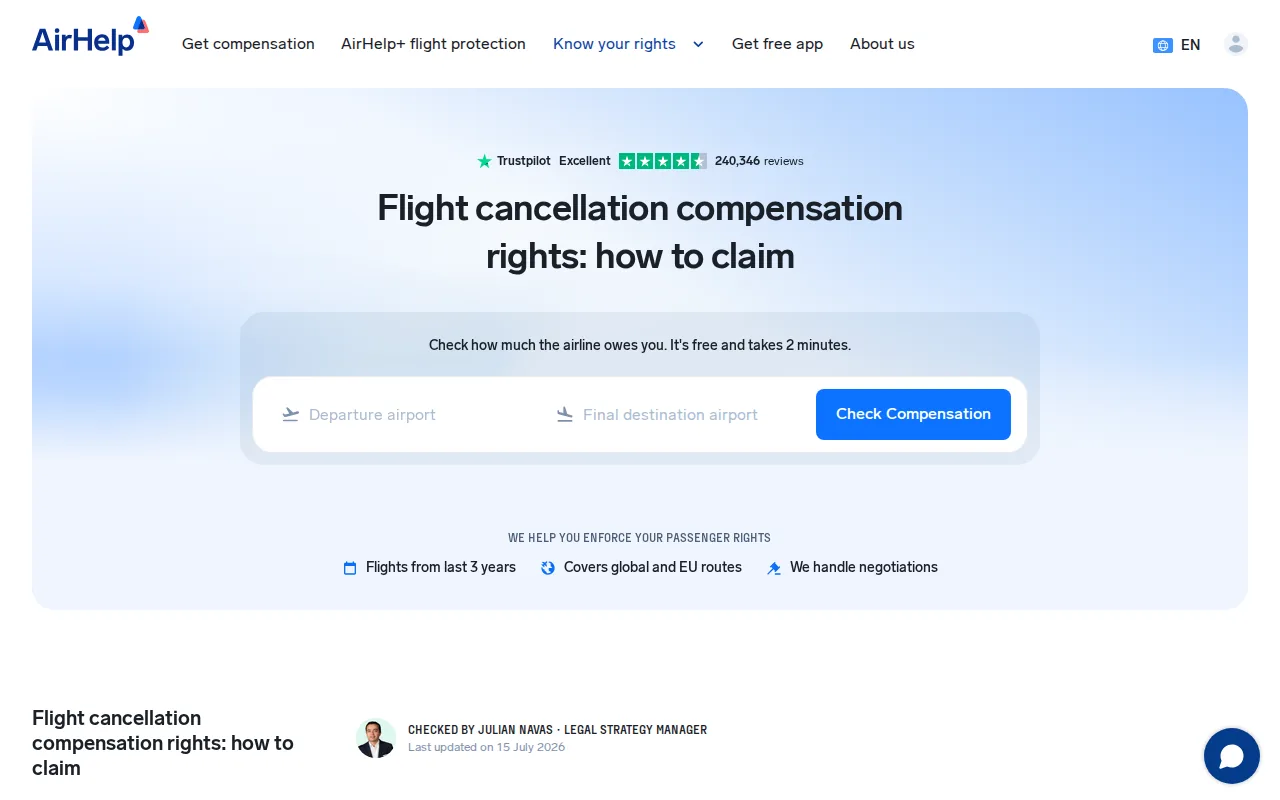
If your cancelled flight falls under EU Regulation 261/2004, you may be entitled to cash compensation of €250 to €600, depending on flight distance. This applies to flights departing any EU airport and to flights arriving into the EU on an EU-based carrier. It also extends to Iceland, Norway, and Switzerland.
The compensation tiers by distance look like this:
Airlines regularly fight these claims by calling the disruption an “extraordinary circumstance” , the regulatory carve-out that removes their compensation obligation. But not every claim they deny is legitimate. Airlines cutting flights for commercial reasons (fuel costs, scheduling optimization) doesn’t automatically qualify as extraordinary. If the airline made a business decision rather than a safety one, file the claim and make them prove it.
That’s where AirHelp and ClaimCompass come in. Both handle all the paperwork, correspondence with the airline, and any escalation needed to collect EU compensation. AirHelp charges a 35% fee. ClaimCompass charges 44%. The net cash you receive will be noticeably less than the headline €600. On a smaller award, the math gets tighter. But if you don’t want to deal with an airline’s legal team in a language you may not speak, paying for that service can be worth it.
One limitation to know upfront: neither service can help you if the delay or cancellation was genuinely caused by extraordinary circumstances , a major storm, an air traffic control strike external to the airline, a security incident. In those cases, you’re entitled to care (hotel, meals, transport) but not the cash compensation.
Every claim you make , to the airline, to your credit card company, to your travel insurer, to the DOT , lives or dies on documentation. If you don’t have a record of it, it didn’t happen. That’s not a figure of speech; claims adjusters require evidence.
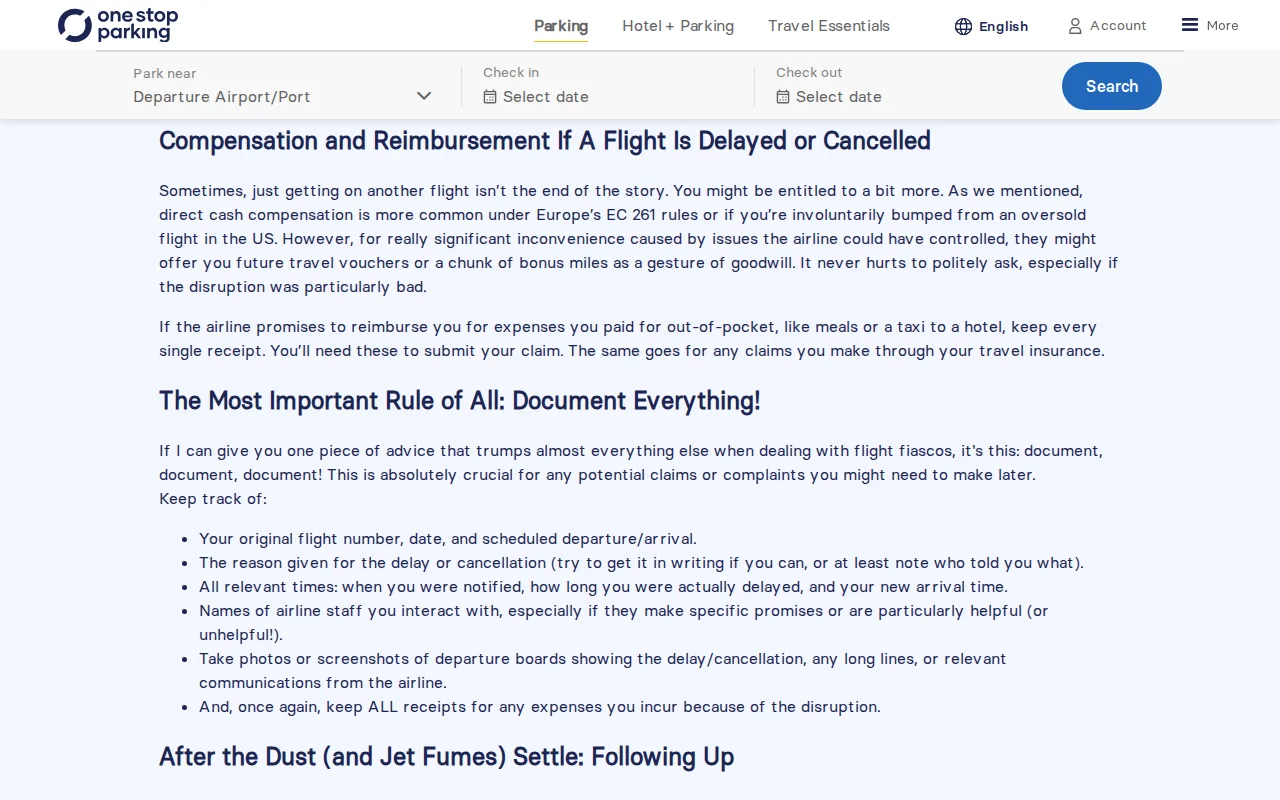
Start the moment you know the flight is cancelled. Screenshot the notification from the airline app. Save any text messages or emails. Keep your original boarding pass. If you talk to an airline agent in person, write down their name and the time of the conversation.
For every expense you incur because of the cancellation , hotel, meals, taxi, even a phone charger if yours broke , get a receipt. Take a photo of it immediately. Paper fades, pockets lose things, and you may not think about reimbursement until you’re home a week later and the receipt is gone.
Ask the airline for written confirmation of the delay or cancellation and its official cause. This document is what your credit card issuer and travel insurer will ask for first. Delta has a web form for this. Most other carriers handle it through customer service. Get it in writing before you leave the airport , it’s harder to obtain after the fact.
If you’re rebooked on a later flight, save that new boarding pass too. A clear paper trail , original booking, cancellation notice, rebooked itinerary, and all expenses in between , makes every downstream claim faster and less likely to be denied.
If you’ve asked the airline for a refund you’re legally owed and they’ve stalled, deflected, or simply stopped responding, the US Department of Transportation takes formal complaints and uses them to track patterns of non-compliance.
Filing a complaint won’t get you money directly. The DOT doesn’t adjudicate individual disputes the way a small claims court would. What it does is create an official record. Airlines with high complaint volumes face regulatory scrutiny. In some cases, a complaint in the system is enough to prompt the airline to resolve your case, because they’d rather not have the DOT asking questions.
When you file, include everything: your booking confirmation, the cancellation notice, records of any communication with the airline, and a clear statement of what you requested and what you received. The more specific you are, the more useful the complaint is.
For flights that fall under EU jurisdiction, each EU member state has a national enforcement body that handles passenger rights disputes. The process is similar: file a formal complaint, include your documentation, and give the airline a reasonable window to respond before escalating. Airlines cannot automatically claim extraordinary circumstances to dodge compensation without proving it.
The DOT complaint process is one of the few tools that costs you nothing and creates lasting pressure. Use it when direct communication fails.
Getting on a new flight is step one. Then you need to deal with everything downstream of it.
Hotel bookings are the most time-sensitive. If you had a non-refundable room reserved for tonight and your new flight doesn’t land until tomorrow, call the hotel before the check-in window closes. Explain what happened. Many hotels , especially independents and smaller properties , will waive the cancellation penalty when you give them advance notice and a clear reason. It’s not guaranteed, but it costs you nothing to ask, and most front desk managers would rather rebook you for tomorrow than charge you for a room you never used.
Rental cars are trickier. Major rental companies hold your reservation for a limited window , sometimes as little as 30 minutes past the pickup time , before releasing the vehicle. Call ahead, update the pickup time, and get a name. If you’re rebooking an international trip and arrival timing shifts by a full day, cancel and rebook to avoid a no-show fee.
Pre-paid tours and activities are the most variable. Some operators have strict no-refund policies within 24 hours. Others are flexible with documented flight cancellation proof. Always contact the operator directly rather than assuming. For a trip where the timing really matters , a fixed-date cooking class, a guided trek with a limited group size, a timed-entry museum visit , this is the call to make right after you’ve sorted your new flight.
For travelers planning a trip that requires precise timing on every leg, building a smarter initial itinerary matters more than managing the fallout. Our guide to how far in advance to book international flights covers how booking timing affects flexibility and what fare classes actually give you room to move if plans change.
One smart move after a significant disruption: use your points. If you’re already accumulating miles on a rewards credit card and a rebooking pushes you into a last-minute fare, redeeming points for the difference can cut your out-of-pocket cost meaningfully. That’s a tactic worth having set up before the next disruption, not scrambling to figure out during one.
Yes. Under US DOT rules, you’re entitled to a full cash refund if your flight is cancelled for any reason , including weather , as long as you choose not to travel and decline the rebooked flight. The refund must come within seven days for credit card purchases and 20 days for other payment methods. Weather cancellations don’t affect your right to a refund; they only affect your right to hotel and meal vouchers from the airline.
Under EU Regulation 261/2004, compensation is owed if you were notified of the cancellation less than 14 days before departure and the disruption wasn’t caused by extraordinary circumstances. For delays, you’re entitled to compensation if you arrive at your final destination three or more hours late. The airline must pay within seven days of the cancellation. Cash compensation rights are separate from your right to care (meals, hotel, transport), which applies regardless of the cause.
No. AirHelp and ClaimCompass only handle claims under EU Regulation 261, which covers flights departing EU airports or arriving in the EU on EU carriers. For US domestic flights, there’s no equivalent statutory cash compensation for cancellations. Your options in the US are a full refund if you decline rebooking, whatever the airline voluntarily offers for controllable disruptions, credit card trip coverage, and travel insurance.
You don’t have to accept it. If you’re legally entitled to a cash refund, the airline must tell you that, and you can insist on money back to your original payment method. Miles are speculative value , airlines devalue their programs regularly, and the offer may be worth less than it sounds. If you do accept miles, use them quickly. A cash refund is always the safer baseline to compare against before you decide.
It matters for some things, not others. Your right to a full refund (if you decline rebooking) is the same regardless of cause , airline fault, weather, anything. Hotel vouchers and meal compensation in the US are typically only provided for controllable disruptions (mechanical, staffing). In Europe, care is owed no matter what. Cash compensation under EU 261 is owed unless the airline proves extraordinary circumstances caused the disruption.
Call the airline’s customer service line at the same moment you join the gate agent queue , do both simultaneously. Phone agents have the same tools as gate agents but shorter wait times during disruptions. Open the airline’s app at the same time; many carriers now allow self-service rebooking on alternate flights or partner carriers. Come prepared with one or two specific flights in mind so the conversation moves faster when someone picks up.
A cancelled flight is frustrating. It’s also a process , and the travelers who come out ahead are the ones who know the process before they need it. Start with the airline, know your refund rights before you say yes to anything, document everything, and layer in credit card coverage and travel insurance for what the airline won’t touch. If you’re flying a route covered by EU 261, AirHelp or ClaimCompass can handle the heavy lifting for a fee. And if the airline stonewalls you, the DOT complaint process is free and creates real pressure. For everything else you need to plan a trip that holds together even when the first flight doesn’t, our guide to finding and booking flights strategically is a good next read.
Missed your connecting flight? Here are 10 options to get rebooked fast, claim compensation, and protect your trip — with honest advice from Dream Book Travel.
Find the cheapest days to fly with real pricing patterns, booking windows, and tools that actually work — no fluff, no affiliate spin.
Discover the exact days and times that give you the lowest flight fares. Follow our data‑backed list and book smarter.